PC Polycarbonate Pellets 3D printing pellets
PelletsPellet · FGF / FDM · Industrial pellet 3D printer

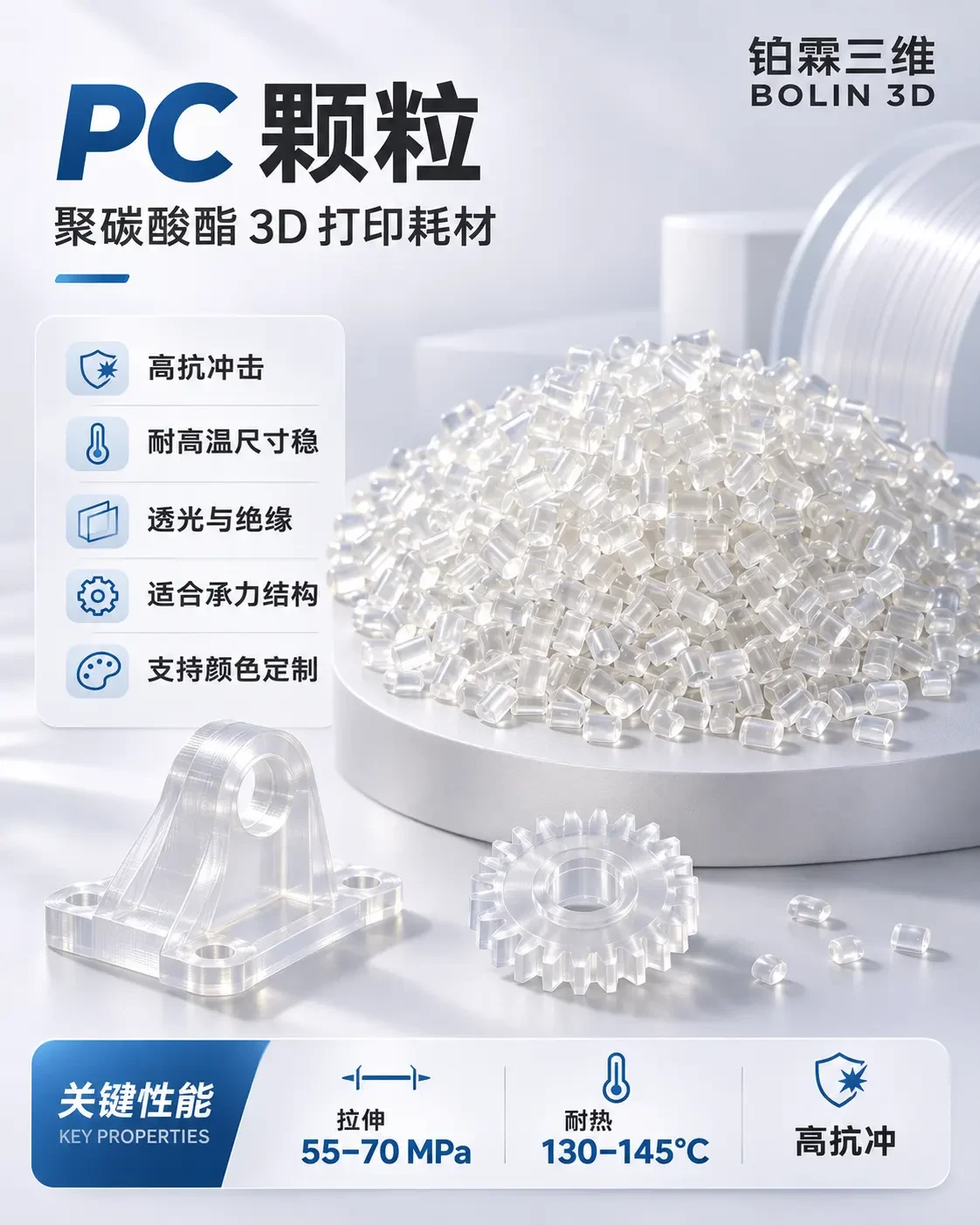
PC Polycarbonate Pellets

An engineering grade with standout impact strength, heat resistance above 130℃ and translucency, for high-temperature duty, load-bearing structures and electrical insulation in large parts.

  • BL10-C supported
  • Tensile 55–70 MPa
  • Heat 130–145 ℃
  • High impact
Extrusion temp.
260–310 ℃
Bed temp.
90–110 ℃

Key features

Standout impact strength

Around 34.8 kJ/m² keeps protective structures from brittle failure on impact.

Heat resistant and stable

Heat deflection of 117–145℃ holds structural integrity in hot service.

Translucent and insulating

Natural translucency plus good electrical insulation suits electrical and optical parts.

Drying process included

Ahead of printing, 80℃ for 8h in a convection dryer reduces bubbles and silver streaks.

Applications

  • High-temperature parts
  • Electrical & insulation
  • Translucent structures
  • Automotive & transport
  • Load-bearing tooling
  • Large protective guards

Factory inspection

Bulk density 0.63–0.66 g/cm³, moisture and MFR checked per batch; drying card plus BL10-C sample verification included.

Physical properties

Density
1.20 g/cm³ASTM D792
Bulk density
0.63–0.66 g/cm³ISO 60
Tensile strength
55–70 MPaASTM D638
Flexural strength
80–108 MPaASTM D790
Flexural modulus
2.0–2.5 GPaASTM D790
Impact strength
≈ 34.8 kJ/m²ISO 179
Heat deflection temp.
117–145 ℃ISO 75(0.45MPa)
Melt flow rate
15–32 g/10minASTM D1238(300℃/1.2kg)

Recommended process settings

Extrusion temp.
260–310 ℃
Bed temp.
90–110 ℃
Pre-print drying
80 ℃ / 8 h
Environment
Heated chamber

Compatible equipment

BOLIN BL10-C direct pellet extrusion: officially supported; a heated chamber plus 60–120℃ bed handles high-temperature forming. PC absorbs moisture, so dry at 80℃ for 8h first. Comparable FGF systems need nozzles stable to 280–310℃ and a fully enclosed chamber.

Figures are typical test values; actual results vary with machine, formulation, process and environment.

Custom colors available

Related models

All pellets →
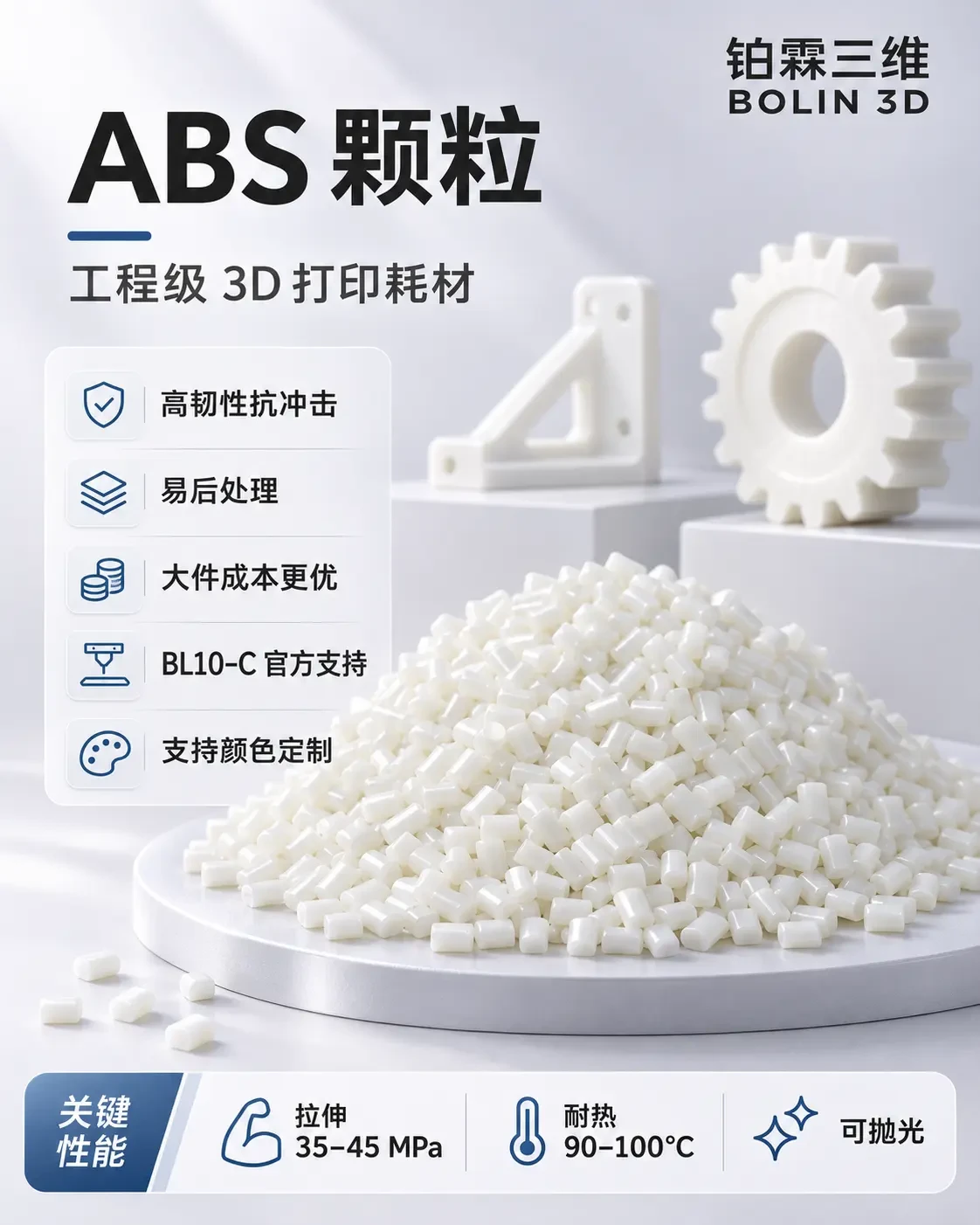
ABS Engineering Pellets 3D printing pellets

ABS Engineering Pellets

Pellet · FGF / FDM · Industrial pellet 3D printer

  • Tough and impact resistant
  • Lower cost on large parts
  • Officially supported by BL10-C
Density
1.04 g/cm³
Tensile strength
35–45 MPa
Flexural strength
60–70 MPa
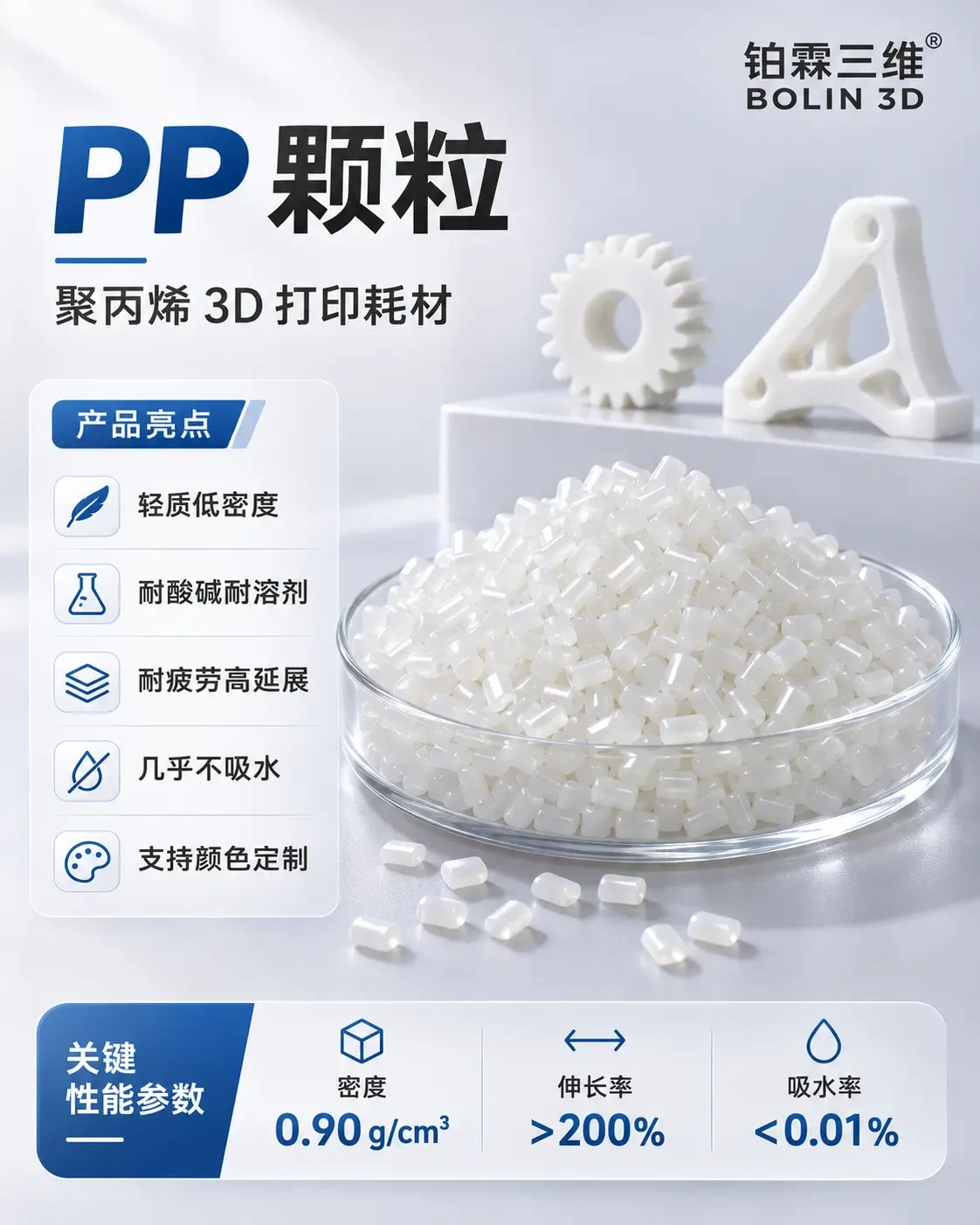
PP Polypropylene Pellets 3D printing pellets

PP Polypropylene Pellets

Pellet · FGF / FDM · Industrial pellet 3D printer

  • Light with low density
  • Resists acid, alkali and solvents
  • Almost no water absorption
Density
0.90 g/cm³
Melting temperature
160–170 ℃
Tensile strength
30–35 MPa
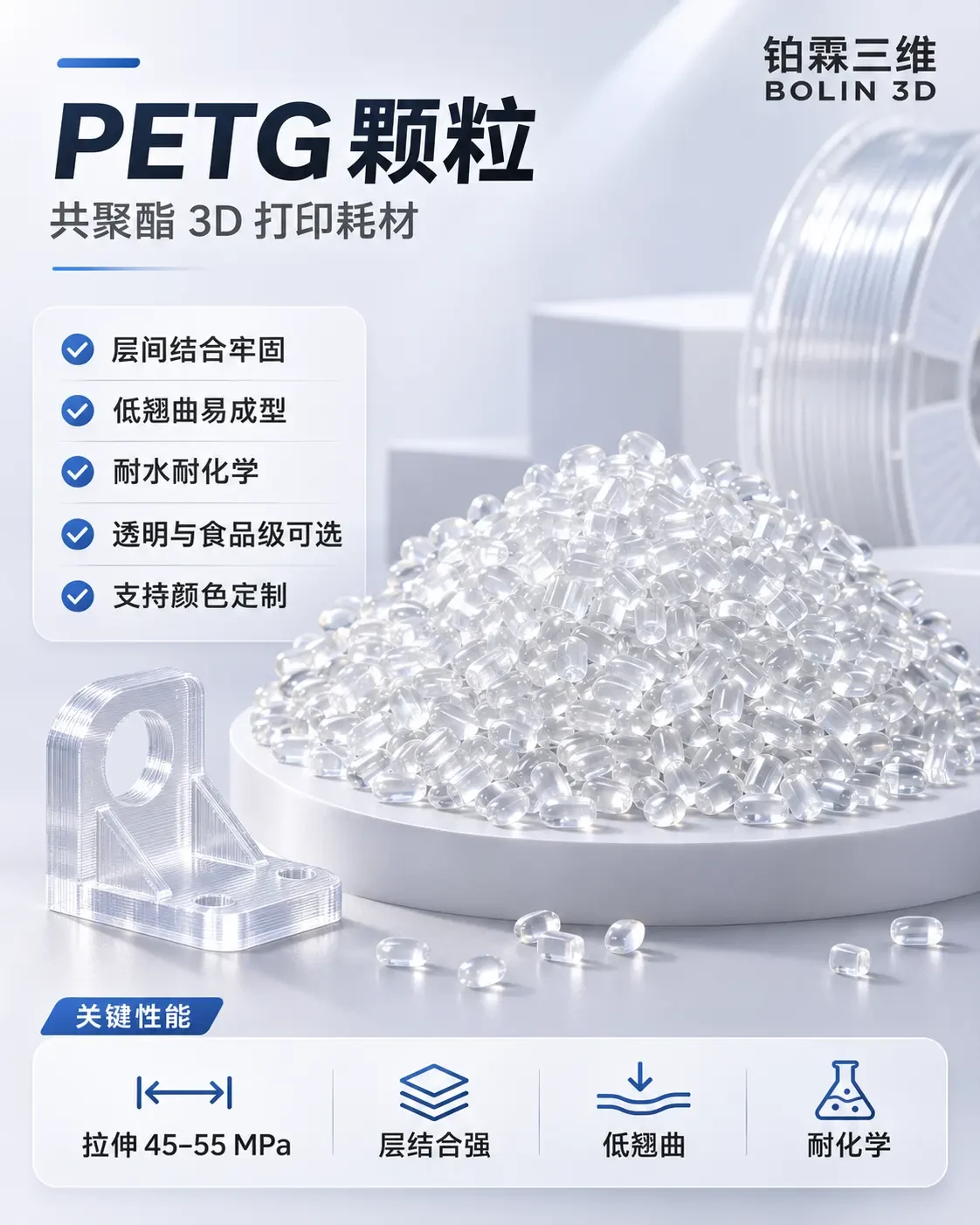
PETG Copolyester Pellets 3D printing pellets

PETG Copolyester Pellets

Pellet · FGF / FDM · Industrial pellet 3D printer

  • Strong layer bonding
  • Low warpage, easy forming
  • Clear or food-grade options
Density
1.27 g/cm³
Tensile strength
45–55 MPa
Flexural strength
65–75 MPa

Ask about samples and bulk supply

Share part size, material and output needs; our engineers match machine, pellet grade and screw process parameters.

Request a solution

Tell us what you need to build

Used only to reply to this inquiry.

Bolin 3D

BOLIN 3D · SINCE 2008

Industrial 3D printing systems, materials and custom print services for aerospace, medical, automotive, creative and precision manufacturing.

Factory address

Plant 1, Dingxing Intelligent Emergency Equipment Industrial Park, 260 m south of the intersection of Qingliangsi Avenue and Zhenxing Road, Liangyuan District, Shangqiu, Henan, China

Mon–Sat 08:30–18:00, 24/7 technical support

Language & region

© 2026 Henan Bolin 3D Printing Co., Ltd. · All rights reserved

Request a solution
WhatsAppRequest a solution